Kirti Kande- Week 9- The Power of the Electoral College
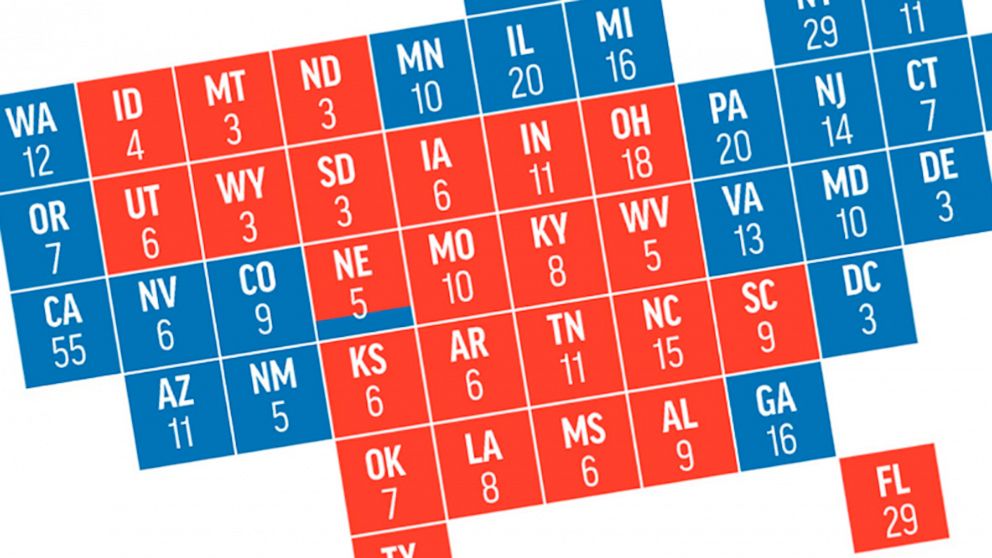
The Power of the Electoral College
By: Kirti Kande P3
When given the topic of Language and Power, I was confused. What should I discuss and write? After pondering, the electoral college popped into my head. The electoral college is a system that decides who should hold the highest office of the land, the President. What else could be more powerful? You would think a system that essentially decides our President, the leader of our country, would be perfect; however, that is far from it.
When we vote for the President, we are not voting for him/her; rather, we are voting our state representatives in the Electoral College who then go on to decide who will be the President. Most states, 48, use a winner-takes-all system making it easy for presidential candidates to win and prompting candidates to only focus on battleground states because they know no matter how much campaigning they do, some states will always be for one party. An example is our own state California. Almost no presidential candidate has spent their time campaigning in California because everyone knows that it is a blue state; only on a very few occasions, it has been red. However, battleground states like Florida and Georgia are states where candidates focus their time, money, and attention. The electoral college gives precedent to smaller, less populated states compared to larger, highly populated states. Essentially, the electoral college devalues the vote of the majority of the population; it takes away their power and impact on the American government, a government that is supposed to be based and built around the wants of the people.
In the 2000 Bush versus Gore election, Gore won the popular vote, the vote of people; however, Bush won the electoral college making him the President. Again, in the 2016 Trump versus Clinton presidential campaign, Clinton won the popular vote; however, lost in the electoral college making Trump the president. So, in reality, Trump and Bush did not win amongst the American people but a system.
This begs the question, do the people of the United States hold the power to elect the President, or does a 218-year-old system?
Hey Kirti, our 218-year-old electoral college really has been a confusing topic for me when I had learned about its details in eighth grade history class. Why would a nation built on democracy allow their most important governmental position to be chosen by a closed group of individuals? My eight grade teacher, Mr. Pagan (great teacher by the way), reasoned this was done to prevent people from electing whoever they wished into a position that grants powerful abilities. At first, this really did not make sense; was that not the whole point of democracy, to be able to elect whoever the people pleases? However, Mr. Pagan goes on to explain that if such a system was set, there really was not anything preventing young adults, who make up a large majority of our population, from electing their favorite pop stars for the next president. This, to my eight-grade self, seemed to make sense. However, thinking back now with more political knowledge, this system no longer seems to make that much sense. Looking at past population votes, not a single pop singer has seemingly been able to gain any significant influence, thus this use of an electoral college really does not seem to serve its purpose any longer. Maybe you are right, it is indeed time to change our political system.
ReplyDeleteThe electoral college is a very confusing and problematic institution. Honestly, I did not understand its purpose for a long time. Considering its 218 year life, it is very surprising that such a system that is clearly biased towards a minority has lasted so long. However, the reason is simple: the US government's system of presidential elections was created so that a landed gentry would have the majority of power rather than the common man. By giving the power to small states, that were often richer than larger ones due to a higher proportion of the population being rich, the states assured that the real power to change policy and make policy would remain in the hands of the well to do. Money really is power.
ReplyDeleteHey Kriti! I remember learning about the electoral college a few years ago, and this was a great memory jogger. The electoral college is most certainly not a perfect system, but it is an example of an attempt to balance power across the nation to ensure satisfactory results. There are definitely some faults, one being “faithless electors” who go against the state’s votes. It also forces many voters to essentially pick between two decent, sometimes even undesirable candidates, making it impossible for a third party to win. This creates a very dominant two party system that frankly seems to be very outdated. Thank you for sharing!
ReplyDeleteHi Kirti, I’m glad you explained how our presidents are elected in your blog because I never truly understood how the electoral college worked and how it overruled the decision of the popular vote. After reading your blog, I agree that there needs to be a change in our system to allow all Americans to be represented rather than having candidates to support them because it would truly carry out the desires of all of its citizens. Oftentimes, it is difficult to make changes in our system, however, since it benefits rich and powerful individuals who do not want to lose their control. I still have hope though that with enough support, all Americans will be able to be represented in crucial elections rather than biased candidates.
ReplyDeleteHi Kirti, I think the attempt to protect the small, rural states from the highly-populated states getting more influence with the electoral college is very outdated. The winner-takes-all system you mentioned causes candidates to focus on the swing states like Ohio, Florida, and Philadelphia while also creating a disproportionate influence that contradicts the democracy our nation values. Because of how the electoral college is set up, further votes are essentially futile if the vote for a specific candidate in a state is just over 50%; additionally this dissuades people from voting because they feel like their votes don’t matter.
ReplyDeleteHi Kirti! I remember learning about the electoral college in middle school and being very confused about why smaller states got more preference over larger states like California, when we represent many more people. The system has lasted a very long time, but I think that it is outdated and should be modified to reflect our current society. While we call the process democratic, we technically do not have much authority over who becomes president, but the people we elect to choose the president have more of this power. Our current two party system is flawed, especially since one party with a majority of seats in the Senate or House of Representatives essentially has a majority of the power.
ReplyDeleteHi Kirti! From your blog, I learned so much about the electoral college and presidential elections in America. Before, I had no idea that the electoral college vote and the popular vote in presidential elections were so different. I also figured they were quite similar, but it turns out I was wrong. I wondered why it was implemented 218 years ago that presidential elections should be determined by electoral college vote rather than the popular vote. I did some research and found that this system was put in place by the Founding Fathers to try and make the presidential election harder to corrupt. Thank you for sharing!
ReplyDeleteThe Electoral College is such a hard concept to wrap my head around because I've always thought of the electoral system to be an incredibly corruptible system. Media does not get everything right but so many depictions of election cycles show the way the cycle can be corrupted. Over and over again we are shown that the political system has naught to do with public opinion and mostly to do with connections.
ReplyDeleteHi Kirti, I was aware of this system and the way it functions, but I never really understood why. The fairest method to me would be to go by the people's direct votes. However, there are probably reasons why our government functions this way. This is an interesting topic to look at and I will probably do some research about how the system works to understand the reasons for this seemingly corrupt system.
ReplyDelete